The best firm pillow, and what firm actually means
There is no firmness scale for pillows. Nobody defines what firm means on a pillow label, so the word is the maker's opinion rather than a measurement, and two pillows both sold as firm can feel nothing alike. Buy the mechanism instead of the adjective.
Firmness in a pillow comes from two things: what the fill is made of, and how much of it is in the case. Only the second is still yours to change after you buy, which is why our pick for a firm feel is an adjustable one.
The PlushBeds Shredded Latex + Kapok lets you pack in more fill until the pillow is as dense as you want it, and its maker documents it as moderate to firm.
If what you actually want is a pillow that does not sink away under your head overnight, that is a different property, and the PlushBeds Solid Latex Pillow is the steadier buy at a medium-density fixed core. Both are $119 to $139 by size and both are non-returnable.
One caveat we will not hide: neither pillow is sold as firm, so we do not call either one firm. This is comfort guidance, not medical advice.
We may earn a commission if you buy through the links on this page. How we make money
Our top picksHow we picked
We are a research desk, not a sleep lab, so this is not a hands-on firmness test, and we are not going to print a number we cannot source.
We judged pillows on what the maker actually documents about the feel, on whether the firmness can be changed after purchase, on whether the material holds a firmness or drifts away from it, and on the fine print around a pillow you cannot return.
Two limits stated openly. First, we recommend only products whose specifications, current price and stock we have verified ourselves, and the pillows that clear that bar for us today are both PlushBeds models. That describes our coverage, not the whole market.
Second, we left our usual value pick off this page on purpose: the Melara Max, which appears on our position pages at $69.95, publishes no firmness specification at all. It is a pre-contoured foam shape, and a page about firmness is not the place to guess at one.
We make no medical claims about pillows and leave advertiser language of that kind out.
The two picks
They are the same material at the same price in two builds, and on this page the difference is the whole point: one lets you set the firmness, the other holds one level for good.
Best pillow for a firm feel, because it is the only one you can make firmer
PlushBeds Shredded Latex + Kapok Pillow
GOLS-certified organic shredded natural latex and kapok fill, breathable cotton cover, adjustable fill, Standard to King
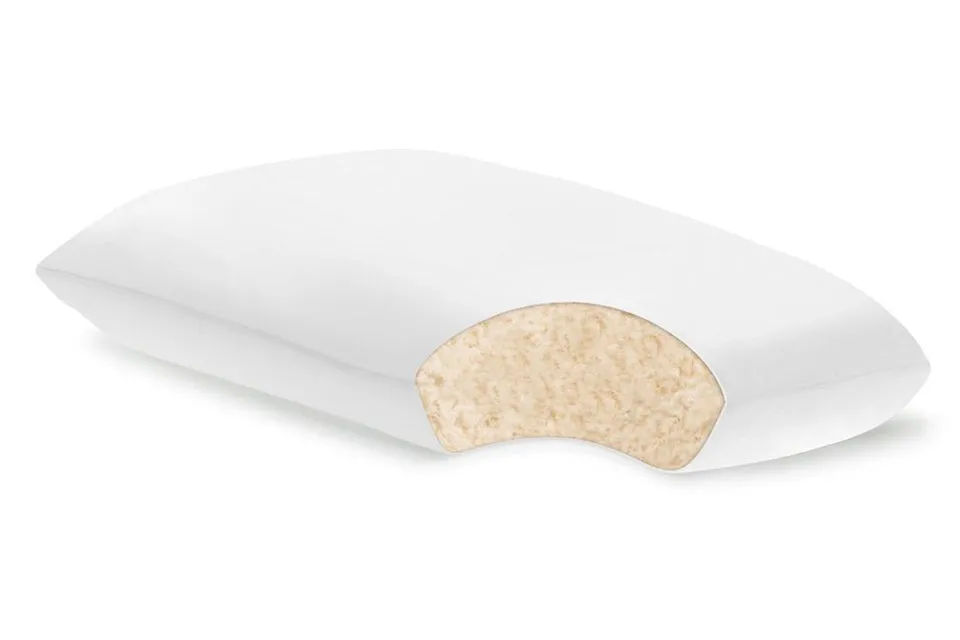
Standard $119, Queen $129, King $139
Start with what its maker actually calls it, because that is the honest starting point on a page about firmness. PlushBeds describes this pillow as giving "moderate to firm support" with a "fluffy, moldable texture". Not firm. Moderate to firm, which is a stated spec rather than a marketing adjective.
What makes it our pick anyway is the mechanism underneath. The fill is loose shredded natural latex blended with kapok, and PlushBeds' own instruction is that you can compress it or plump it to adjust the pillow. On a loose fill, firmness and quantity are the same dial.
Pack more fill into the same case and the pillow gets both taller and denser under your head. That is the only route to a firmer pillow that stays available to you after the box is open, because every fixed pillow, however it is labelled, arrives at one firmness and keeps it.
Latex is the right material for that job because it springs back instead of packing down into a flat spot, so the firmness you set is roughly the firmness you keep. The fill is GOLS-certified organic, an audited material claim, under a breathable cotton cover, with a 3-year warranty.
Keep in mind: The pillow is non-returnable for safety and sanitary reasons, so adding or removing fill is your only way to correct the feel after it arrives. A shredded fill also needs an occasional fluff to stop it clumping, which is PlushBeds' own care note and something a solid core never asks of you.
Best for: Anyone who wants a firmer pillow than average and would rather set the level themselves than trust a word on a label.
Key specifications
| Fill | GOLS-certified organic shredded natural latex and kapok |
|---|---|
| Firmness (maker's words) | Moderate to firm support, fluffy and moldable |
| Adjustable | Yes, add or remove fill |
| Loft as shipped | Standard 4 in, Queen and King 5 in |
| Cover | Breathable cotton |
| Sizes | Standard, Queen, King |
| Warranty | 3 years |
| Returns | Non-returnable (safety and sanitary regulations) |
Best if firm means a pillow that never sinks under your head
PlushBeds Solid Latex Pillow
Solid 100% natural Talalay latex core, medium-density, fixed 4.5 inch loft, cotton sateen cover, Standard to King
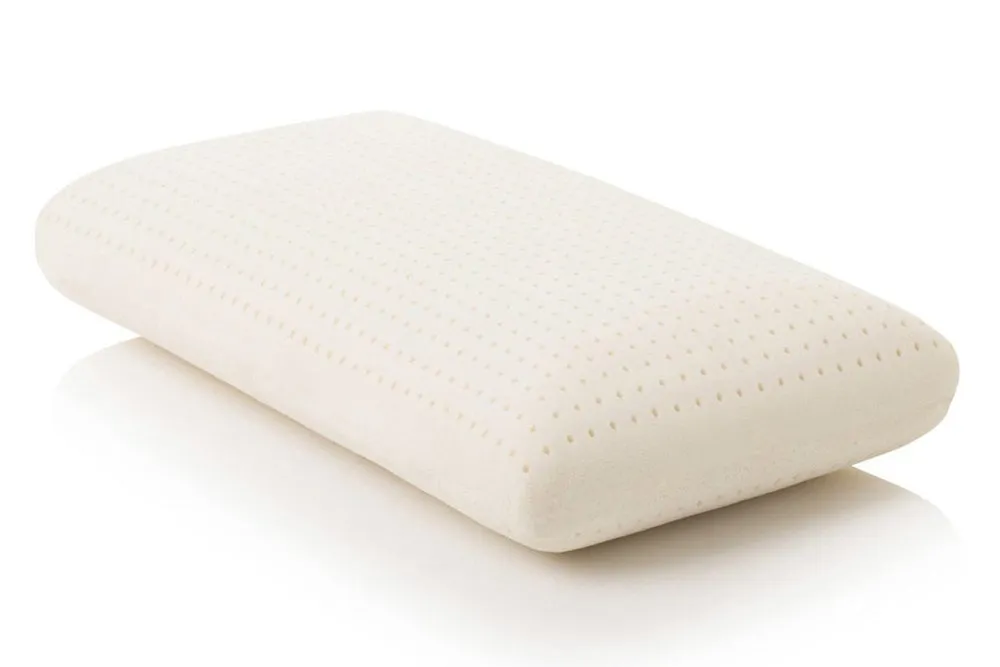
Standard $119, Queen $129, King $139 (the King was not available to order when we checked)
Its maker calls this one medium-density, and we are not going to call it firm on its behalf. It earns a place here for a different reason. A large share of people shopping for a firm pillow are not chasing a hard surface at all, they are trying to stop a pillow sinking away under the weight of their head by 2am.
That is resistance over time rather than resistance at first touch, and a single moulded core is the most reliable way to buy it. There is nothing loose inside to redistribute, so the support at 6am is the support you lay down on, and PlushBeds' claim for it is that it maintains its shape with no need for fluffing.
The core is 100% natural Talalay latex at a fixed 4.5 inch loft, with a 3-year warranty. Open-cell Talalay sleeps cooler than memory foam and does not soften as it warms. No certification is stated for this pillow, so natural Talalay latex is the claim here, not organic.
If that is the shape of your complaint, this is the simpler purchase of the two, with nothing to set up and nothing to maintain. If you want an actively hard pillow, it is not that, and no amount of reading the label will change a medium-density core. Note too that 4.5 inches suits most back sleepers but is often too low for a dedicated side sleeper.
Keep in mind: Neither the firmness nor the 4.5 inch loft can be changed, and the pillow is non-returnable, so that height has to suit you first time.
Best for: People whose real complaint is a pillow that flattens under them overnight, and who already know a medium 4.5 inch height suits them.
Key specifications
| Fill | Solid 100% natural Talalay latex |
|---|---|
| Firmness (maker's words) | Medium-density |
| Adjustable | No, fixed core |
| Loft | Fixed 4.5 in in every size |
| Cover | Breathable cotton sateen |
| Sizes | Standard, Queen, King |
| Warranty | 3 years |
| Returns | Non-returnable (safety and sanitary regulations) |
Why firm is not a spec
Mattress shopping trained everyone to expect a firmness number, and pillows quietly do not have one. We looked for a published pillow firmness scale we could cite and did not find one to verify, and no standards body defines the word for a pillow label.
So firm is the maker's own description, applied at the maker's own discretion, on a product where the same word covers a hard buckwheat casing and a softish foam block.
That has a practical consequence. A listing that says firm and nothing else has told you nothing you can act on. What is worth reading is concrete: what the fill is, whether the amount of fill can be changed, and what loft the pillow is stated to arrive at. Those three tell you how the pillow will behave.
We take the same position on latex figures elsewhere on the site, where we decline to publish density and ILD numbers we have not verified, rather than repeating figures that circulate without a source.
The two things people mean by firm
Ask two people why they want a firm pillow and you get two different answers. One wants a surface that pushes back the moment their head lands. The other wants a pillow that is still holding them up at 4am instead of having quietly flattened.
Those are different properties, they are delivered by different things, and buying for the wrong one is how people end up disappointed by a pillow that is technically exactly what they asked for.
The RestVerdict firm-pillow split. People asking for a firm pillow want one of two different things. Resistance now is a surface that pushes back the moment your head lands, and it comes from hard fills such as buckwheat hulls, from a dense moulded core, or from packing extra fill into an adjustable pillow.
Resistance later is support that is still holding you up at 4am, and it comes from springy materials such as latex, while down and polyester fills collapse under the head instead.
Underneath both: no published pillow firmness scale exists, so the word firm on a label is the maker's own, and the only firmness you can change after buying is the amount of fill in an adjustable pillow.
If your complaint is resistance later, you may not need a firmer pillow at all, you need a material that springs back. That is a fill question, and our guide to the best latex pillow covers the two ways latex is built to do it.
What each fill can do on firmness
Firmness is a property of the fill, not of the brand. Here is what each of the common fills can and cannot deliver, and where the catch is in each case.
| Fill | Can it be firm | How the firmness is delivered | The catch |
|---|---|---|---|
| Shredded latex | Yes, and adjustable | More fill in the same case means a denser, taller pillow; less fill softens and lowers it | Firmness and height move together, and the fill needs an occasional fluff |
| Solid latex | Steady rather than hard | A moulded core resists constantly and springs back instead of packing down | Whatever density it is moulded at is what you own for good |
| Solid memory foam | At first, then less so | A dense block feels firm underhand | It is designed to soften as it warms under your head, so the feel at midnight is not the feel in the shop |
| Shredded memory foam | Somewhat, and adjustable | Same fill-quantity dial as shredded latex | Packs down faster than latex, so a firm setting drifts softer over months |
| Buckwheat hulls | Firmest of the common fills | Hard hulls stack against each other and barely compress; the amount is adjustable | Heavy, and the hulls rustle audibly when you move. We have verified no buckwheat pillow, so we name none |
| Down and down alternative | No | Nothing in the fill resists compression | Overstuffing makes it thicker, not firmer, and it collapses again under your head |
General fill behaviour above is established material knowledge. The words used for our own two picks, moderate to firm for the shredded pillow and medium-density for the solid one, are their makers' own, verified 8 August 2026. We give no firmness number for any fill, because we have verified no published figure for one.
How to actually get a firmer pillow
There is one method that works and several that people try first because they cost nothing.
- Add fill, if the pillow allows it. This is the only real adjustment. More material in the same case means more resistance under your head, and on our shredded pick it is the maker's own documented instruction. It is also the only fix available on a pillow that cannot be returned.
- Buy the fill that resists, not the label that says so. If the pillow is fixed, its firmness was decided at the factory and is now a permanent property of the thing you own. The fill table above is the more reliable read than the adjective on the listing.
- Stacking two pillows does not do it. It raises the height, which is a different measurement, and the top pillow flattens exactly as it did before. You have changed your loft, not your firmness, and usually by more than you meant to.
- A firmer pillowcase does nothing. The case holds the fill in place; it contributes no support. A tight case on a shredded pillow can compress it slightly, but this is not a way to buy firmness.
- When a pillow has gone soft, it is finished. A pillow that stays folded instead of springing back, or that has a permanent flat spot, has lost its support, and no amount of fluffing brings it back. Washing does not either. Our guide to washing pillows covers which fills survive a machine and which never go in one.
Who should choose differently
- You are shopping by sleep position. Firmness follows the loft your position needs, so start there instead: the best side sleeper pillow, the best pillow for back sleepers, the best pillow for side and back sleepers and the best pillow for stomach sleepers. Our pillow-fit matrix sets loft and firmness against each position in one table.
- Stomach sleepers. Firmness is close to the wrong question here. What matters is that the pillow is thin, and a firm one at the wrong height is worse than a soft one at the right height.
- You want a genuinely hard pillow. Buckwheat is the fill for that, and we have verified no buckwheat pillow, so we will not point you at one. Buy from somewhere that publishes the hull weight and accept the noise and the weight that come with it.
- Your problem is the bed, not the pillow. If you are sinking into the mattress, the pillow height and feel that suit you change with it, and a firmer pillow will not settle a soft bed. A firm mattress topper is the layer that addresses that, and our topper guides cover when it is worth doing.
- You want to try a pillow and send it back. Neither pick can be returned, for safety and sanitary reasons. On a firmness question that is a real constraint, which is exactly why the adjustable pillow is the safer of the two here.
Working out your height first? Start with our guide to choosing a pillow, and if you are buying cases to match, our standard pillow size guide shows why the pillows we cover do not measure what their labels say. Everything in the section is listed on our pillow guides hub.
Others we considered
Melara Max Pillow. Our usual value pick at $69.95, and it appears on our sleep-position pages, but it is not a pick here. Melara publishes no firmness specification for it at all.
On a page whose whole point is that the word firm is unverifiable, recommending a pillow with nothing stated about its feel would be guessing. It is a pre-contoured foam shape, so the position pages are the honest place for it.
A buckwheat pillow. In general fill terms this is the firmest of the common fills, and the fill amount is adjustable, so it is the obvious answer for anyone who wants a genuinely hard pillow.
We have verified no buckwheat pillow ourselves, so we name none rather than pointing you at one we have not checked. If you go that way, expect the weight and the audible rustle that come with hulls.
Common questions
Is there a firmness scale for pillows?
Not one we can point you to. Mattresses have published firmness and density figures; for pillows we found no comparable published scale to verify, and no body defines what firm means on a pillow label. So two pillows both labelled firm can feel nothing alike. Read the fill, whether the fill amount can be changed, and the stated loft instead.
What is the firmest pillow fill?
Buckwheat hulls, in general terms. The hulls are hard and stack against each other rather than compressing, and you set the level by how many are in the casing. The trade is weight and noise: buckwheat pillows are heavy and the hulls rustle when you move. We have verified no buckwheat pillow ourselves, so we name none here.
How do I make my pillow firmer?
Only an adjustable pillow can genuinely be made firmer, by adding fill so the same case holds more material. On a fixed pillow there is no adjustment to make. Stacking two pillows does not work either: that raises the height, a different measurement, and the top pillow still collapses. Firming an adjustable pillow also raises its loft, so expect both to change together.
What is the difference between a firm pillow and a high loft pillow?
Firmness is how much the pillow resists your head; loft is how tall it is. They are independent, and confusing them is the most common mistake in pillow shopping. A thin pillow can be very firm, and a tall soft one can collapse to nothing under your head. Loft is set by your sleep position; firmness is what keeps that loft where you set it.
Do you have a firm pillow pick that is labelled firm?
No, and we would rather say so. Of the pillows whose specifications we have verified, one is described by its maker as moderate to firm and the other as medium-density. Neither is sold as firm, so we do not call either one firm. Our answer for a firmer feel is the adjustable pillow: you add fill until it is as firm as you want.