The best pillow for side and back sleepers
If you split the night between your side and your back, no single fixed loft fits both: your side wants a high pillow to fill the shoulder gap, your back wants a medium one. Aim for a compromise height in the overlap, roughly 4 to 5 inches, and use a pillow you can adjust to land it.
Our top pick is the PlushBeds Shredded Latex + Kapok: an adjustable organic latex pillow whose fill you add or remove to set one loft that works on both sides of the switch, which is the single most useful thing a combination-sleeper pillow can do.
Our value pick is the Melara Max, a pre-contoured memory foam pillow shaped for more than one position at about half the price.
Dedicated side or back sleeper? Our side and back picks fit better. This is comfort guidance, not medical advice.
We may earn a commission if you buy through the links on this page. How we make money
Our top picksHow we picked
We are a research desk, not a sleep lab, so this is not a hands-on test. Combination sleeping sets a harder target than a single position: the pillow has to support a tall side posture and a medium back one without being swapped in the night.
We judged pillows on whether you can set a loft in the overlap of the two ranges, on how firmly they hold that height when you roll, on temperature and materials, and on the honesty of the fine print, using each brand's verified specifications.
We make no medical claims about neck pain, and where an advertiser makes them we leave that language out.
The two picks
One lets you tune a single compromise loft and holds it; the other gives you a ready-made multi-position shape for less. Pick by whether you want to set the height yourself or buy something pre-contoured, not by the star number.
Best overall for combination sleepers
PlushBeds Shredded Latex + Kapok Pillow
Adjustable shredded organic latex and kapok, moderate to firm, Standard to King, GOLS-certified organic
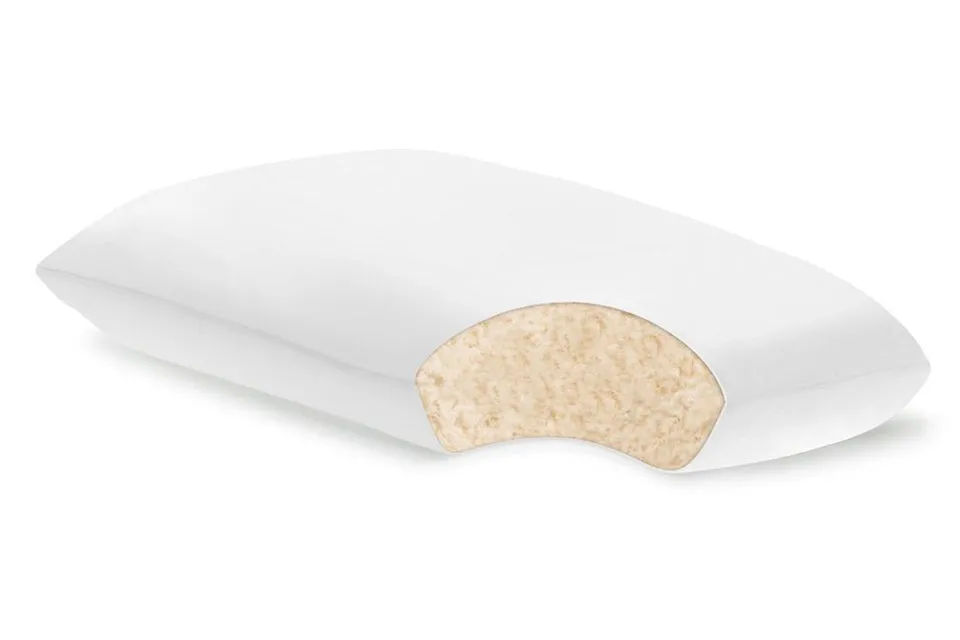
Standard $119, Queen $129, King $139
The whole problem for a side-and-back sleeper is that the two positions want different heights. On your side the shoulder holds your head out from the mattress and you need a tall pillow to fill that gap. On your back the head sits close to the bed, and a tall pillow shoves it up and folds the chin down.
No single fixed height is right for both, which is exactly why an adjustable pillow is the answer here rather than a compromise you buy off a size chart.
You add or remove the shredded latex-and-kapok fill until you land one loft that sits in the overlap of the two ranges, a touch lower than a dedicated side pillow and a touch higher than a dedicated back one, so it works reasonably whichever way you roll.
It starts moderate to firm and holds that height rather than collapsing when you turn. The GOLS-certified organic latex sleeps cooler and lasts longer than memory foam, the cotton cover breathes, and there is a 3-year warranty. Latex is heavier and springier underhand than a basic foam pillow.
Keep in mind: It is non-returnable for safety and sanitary reasons, so adjusting the fill is how you get the fit right rather than sending it back. A shredded fill also needs an occasional fluff to stop it clumping.
Best for: Combination sleepers who split time between their side and back and want to tune one loft to work for both, prefer organic latex, and want a pillow that sleeps cool.
Key specifications
| Fill | GOLS-certified organic shredded natural latex and kapok |
|---|---|
| Cover | Breathable cotton |
| Firmness | Moderate to firm, adjustable by adding or removing fill |
| Loft | Standard 4 in, Queen and King 5 in (adjustable from there) |
| Sizes | Standard, Queen, King |
| Warranty | 3 years |
| Returns | Non-returnable (safety and sanitary regulations) |
Best value, and for a ready-made multi-position shape
Melara Max Pillow
Contoured "butterfly" memory foam with a head cradle and an arm-support wing, cooling cover, one size
$69.95 (single pillow)
If you would rather not set your own loft, the Melara Max is the value alternative, and its shape is aimed at more than one position. It is a contoured memory foam pillow with a cradle for the head, a raised ridge for the neck, and a cut-out wing for the arm you tuck under when you are on your side, all under a cooling cover.
It costs about half what the latex pick does. For a side-and-back sleeper who wants something that works out of the box, the multi-position contour is a reasonable single buy, with no setup and no fluffing.
The honest limits are the ones any moulded pillow carries. There is no fill to add or remove, so you cannot fine-tune the compromise loft the way you can with the latex pick, and it is memory foam, so it sleeps warmer than latex over the night.
Melara is also a young brand, with a site launched in early 2026, so there is a short track record behind it and no material certification is stated. This is comfort and support, not a medical device: we make no claims about snoring, breathing or neck pain.
Keep in mind: The contour is fixed, so it does not change height as you roll from side to back, and it either suits your neck or it does not.
Best for: Combination sleepers who want an inexpensive, ready-shaped multi-position pillow and have liked a moulded pillow before.
Key specifications
| Material | Contoured memory foam, cooling cover |
|---|---|
| Shape | One contoured "butterfly" shape with a head cradle and an arm-support wing |
| Firmness | Medium contoured support |
| Size | 14.5 x 24.4 in, one size |
| Returns | See the merchant's current policy at checkout |
The compromise loft
The trick to buying one pillow for two positions is to stop looking for a perfect height and aim for the band the two positions share.
Side sleeping needs roughly 4 to 6 inches to fill the shoulder gap; back sleeping needs roughly 3 to 5 inches so the head is not pushed up. Those overlap at about 4 to 5 inches, and that overlap is your target: high enough for your side, low enough for your back.
Side sleeping needs about 4 to 6 inches of loft and back sleeping about 3 to 5 inches, so the two ranges overlap at roughly 4 to 5 inches.
That overlap is the compromise loft to aim for with one pillow used in both positions: tall enough to support your side, low enough not to push your head up on your back. An adjustable pillow is the surest way to land inside that narrow band.
Weight the compromise toward the position you actually spend more time in: mostly-side sleepers set it near the top of the band, mostly-back sleepers near the bottom. A softer mattress lets the shoulder sink and lowers the whole picture. The full loft-and-firmness breakdown, across every position and body size, is in our pillow-fit matrix.
Who should choose differently
- Dedicated side sleepers. If you almost always sleep on your side, buy for the full shoulder gap, a taller pillow than the compromise. See the best side sleeper pillow picks.
- Dedicated back sleepers. If you sleep on your back nearly all night, a steady medium loft beats a compromise one. See the best pillow for back sleepers picks.
- Side, back and stomach. If you also spend real time on your front, no compromise loft covers all three, because stomach sleeping needs almost none. Set the adjustable pick low and see our stomach-sleeper picks for how low to go.
- Set against latex. Both picks aim to sleep cool; if you specifically want a moulded foam feel and accept a warmer night, the contoured pick is the one, but you give up the ability to fine-tune the compromise height.
Want the reasoning behind these picks, or shopping for the bed itself? Our pillow guides cover loft, firmness and fill, and the organic certifications guide explains what a mark like GOLS on the latex pick actually verifies, and what it does not.
Others we considered
PlushBeds Solid Latex Pillow. The same latex in the other build, a single moulded core at a fixed 4.5 inch loft, and it leads our back-sleeper guide. On paper it lands inside the 4-to-5-inch compromise band, which is why it was a genuine candidate here.
It did not make the list because a combination sleeper's target is narrow and personal. Shoulder width and mattress firmness move it, and a moulded core offers no way to move with them. If 4.5 inches turns out to be slightly wrong for you, there is nothing to add or remove, and the pillow cannot be returned.
Buying two pillows and swapping. Worth naming, because it is what a lot of combination sleepers end up doing: a tall one for the side, a medium one for the back.
It gives each position its ideal height, and it costs two pillows and a reach in the dark every time you roll. We built this page around one pillow set to the overlap instead, which is what most people actually want.
Common questions
What loft do side-and-back sleepers need?
A compromise height in the overlap of the two positions. Side sleeping wants roughly 4 to 6 inches to fill the shoulder gap; back sleeping wants roughly 3 to 5 inches. The shared band is about 4 to 5 inches. Your exact number depends on shoulder width and mattress, so an adjustable pillow is the surest way to land it. This is comfort guidance, not medical advice.
Can one pillow really work for both side and back sleeping?
Yes, if you accept it as a good compromise rather than a per-position ideal. A single loft set in the 4-to-5-inch overlap supports your side and your back reasonably, which is what most combination sleepers want: one pillow, no swapping in the night. If you spend most of your time in one position, buy for that position and treat the other as the exception.
Is an adjustable or a contoured pillow better for combination sleepers?
An adjustable pillow is usually the better fit. The height that suits both positions is a narrow target, and adding or removing fill lets you hit it precisely. A contoured foam pillow needs no setup, but its height is fixed and the moulded shape either suits your neck or it does not. Choose latex to dial the loft; choose the contour for a ready shape at a lower price.
I sleep mostly on my side but roll onto my back. What should I buy?
Buy for the side, then take a little height out. Start from a side-sleeper loft, around 4 to 6 inches, and if the pillow is adjustable remove a small amount of fill so it does not push your head up on your back. That lands you near the top of the shared range. A fixed side-sleeper pillow will feel too tall every time you roll over.
Can the right pillow stop me waking with a stiff neck?
We talk about comfort and support, not treatment. A pillow that keeps your head and neck roughly level with your spine in both of your sleep positions is more comfortable for many combination sleepers, and that is the honest claim. Persistent neck pain or stiffness is a medical question for a healthcare professional, not something a pillow or a bedding page should promise to fix.